
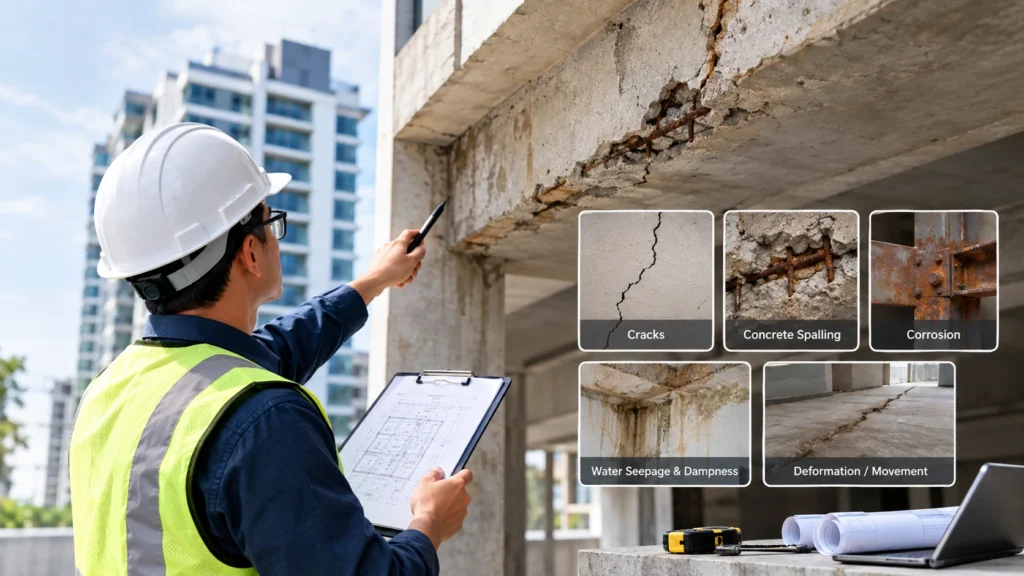
A building can look perfectly normal from the outside while developing defects that need technical attention. Cracks, water seepage, concrete deterioration, corrosion, damaged connections and movement in building elements may develop slowly. Some signs are easy to notice, while others require a trained professional to assess what they mean.
For property owners, facility managers and building operators in Singapore, regular inspection plays an important role in understanding the condition of a property. A professional engineer can examine visible defects, review structural elements and determine whether further investigation or repair may be required.
Singapore’s Building and Construction Authority (BCA) requires Periodic Structural Inspections for most existing buildings. Non-residential buildings are generally inspected every five years, while residential buildings are generally inspected every ten years, subject to the applicable requirements and exemptions.
Why Structural Building Defects Need Professional Attention
Building defects do not always indicate a serious structural problem. A small crack in plaster, for example, may be related to surface movement rather than a structural issue. On the other hand, cracking, corrosion or deformation in a structural element may require closer examination.
This is where professional engineering knowledge becomes useful.
A professional engineer can assess the location, pattern, extent and condition of a defect and consider factors such as:
- The age and construction type of the building
- Previous repair or renovation work
- Visible deterioration of concrete or steel
- Water leakage and moisture exposure
- Changes in building use or loading
- Previous inspection findings
- Maintenance history
- Signs of movement or deformation
The objective is not simply to find defects. It is to understand their condition and determine what should happen next.
What Types of Defects Can Engineers Identify?
Structural problems can appear in many forms. During an inspection, an engineer may look for visible signs across different parts of a building.
Cracks in Concrete and Masonry
Cracks can occur in walls, slabs, beams, columns and other building elements. Their width, direction, location and pattern can provide useful information about the possible cause.
Some cracks may result from normal material movement or ageing. Others may require further technical assessment.
Concrete Spalling and Deterioration
Concrete deterioration can expose reinforcement steel to moisture and air. Once reinforcement begins to corrode, expansion can contribute to cracking and concrete spalling.
An engineer can record affected areas and assess whether further investigation or repair is needed.
Corrosion of Structural Components
Steel components, reinforcement bars, brackets and connections may deteriorate when exposed to moisture or corrosive conditions.
Corrosion is particularly relevant in areas where water repeatedly enters the building or where protective coatings have deteriorated.
Water Seepage and Dampness
Water stains, damp surfaces and recurring leakage can sometimes indicate problems beyond simple surface damage.
An inspection can help determine where the visible symptoms occur and whether the affected area requires further technical investigation.
Deformation or Movement
Uneven floors, unusual movement, deflection or changes around structural elements may require closer attention.
The engineer can document the affected areas and determine whether additional measurements, testing or assessment should be considered.
How Professional Engineers Inspect a Building
A proper inspection involves more than walking through a property and taking photographs. The inspection process generally combines document review, visual examination, site observations and technical assessment.
1. Review Available Building Information
Before visiting the property, the engineer may review available drawings, previous inspection reports, maintenance records and information about addition or alteration works.
BCA’s guidance for building owners specifically highlights the usefulness of as-built structural plans, maintenance history and previous inspection reports when preparing for a Periodic Structural Inspection.
This background gives the engineer useful context before the physical inspection begins.
2. Conduct a Site Inspection
The engineer examines accessible structural and building elements for visible defects.
Depending on the property, this may include:
- Columns and beams
- Slabs and floors
- Walls
- Roof structures
- Accessible foundations or structural areas
- Staircases
- External building elements
- Connections and supporting components
The inspection coverage can vary according to the building’s age, condition, history and observed defects.
BCA’s structural inspection guidance notes that older buildings may require greater inspection coverage where age, observed defects or maintenance history indicate additional areas should be examined.
3. Record Defects and Their Locations
Good inspection records should show where defects were found and what was observed.
Photographs, descriptions, location references and other inspection information can help property teams understand the condition of specific areas.
This information also becomes useful when planning repair work or comparing conditions during later inspections.
4. Assess Areas That Need Further Investigation
Not every visible defect can be fully understood through a visual inspection alone.
Depending on the situation, an engineer may recommend additional investigation, testing, access to concealed areas or specialist assessment.
For example, if a ceiling hides a structural member, access may be required to inspect the concealed component. BCA notes that removal of claddings or false ceilings at selected locations may sometimes be requested when critical structural elements need to be assessed.
Building Condition Assessment Helps With Maintenance Planning
A Building Condition Assessment in Singapore can give property owners a clearer record of visible defects, deterioration and maintenance concerns.
This type of assessment can be useful when a building has:
- A long maintenance history
- Repeated water leakage
- Visible cracks or concrete deterioration
- Ageing external elements
- Planned renovation or alteration works
- Changes in building use
- Unresolved defects from earlier inspections
The findings can help facility teams decide which issues need immediate attention, which areas should be monitored and where further technical review may be required.
For owners looking for Building Inspection Services in Singapore, the scope should be based on the building’s condition, inspection objectives and areas of concern.
Why Facade Defects Should Not Be Ignored
The external facade is exposed to weather, moisture and daily environmental conditions. Over time, materials and connections can deteriorate.
A building facade inspection in Singapore may identify issues such as:
- Cracked or loose tiles
- Concrete cracking or spalling
- Bulging plaster
- Corrosion
- Damaged cladding
- Loose external components
- Deteriorated connections
- Water-related deterioration
BCA states that buildings over 20 years old and more than 13 metres high are subject to Periodic Facade Inspection requirements, with inspections generally carried out every seven years, subject to applicable exemptions.
BCA has also reported that more than 20 fallen facade-element incidents are reported to the authority on average each year.
These figures show why external building elements deserve regular attention, especially as properties age.
What Happens After Defects Are Found?
Finding a defect is only one part of the inspection process. The next step depends on its location, condition, severity and possible cause.
A professional engineer may recommend:
- Routine monitoring for minor concerns
- Localised repair work
- Further inspection or testing
- Investigation of concealed structural elements
- Technical review by a relevant specialist
- Repair or remedial work
- Follow-up inspection after repairs
The appropriate action should be based on the actual condition found at the property rather than assumptions based only on photographs or isolated symptoms.
When Should a Building Owner Arrange an Inspection?
An inspection may be considered when visible defects begin to appear or when a property has reached its scheduled inspection period.
Other situations can include:
- Buying or taking over an older property
- Planning major renovation work
- Repeated water leakage
- Visible structural cracks
- Concrete spalling
- Corrosion
- Changes in building usage
- Concerns raised during routine maintenance
- Previous defects that have returned
BCA also notes that routine maintenance teams can help identify visible deterioration between formal inspections and report concerns so that building owners can engage a professional engineer for technical evaluation when required.
Choosing the Right Inspection Support
Property owners should look for an inspection provider with suitable engineering knowledge, relevant experience and a clear reporting process.
A Building Inspection Company in Singapore may support property teams with general inspection services, while situations involving structural assessment may require a qualified professional engineer.
For facility teams managing multiple building systems, working with a facilities management company in Singapore that understands how inspection findings connect to ongoing maintenance requirements can also be useful.
Vanguard Facility Management Pte. Ltd. provides engineering-led facility and building support for commercial, industrial and other properties. Its wider services can be viewed through its profile as a Building Services Company in Singapore.
How Professional Engineering Inspection Supports Better Decisions
The purpose of a structural inspection is not simply to produce a report. It gives property owners and facility teams information they can use when deciding what needs attention.
A Professional Engineer Inspection in Singapore can help identify visible defects, assess areas of concern and determine whether further technical investigation may be required.
A Structural Building Inspection in Singapore can also provide a documented view of the condition of accessible structural elements, giving building owners a clearer basis for maintenance and repair planning.
Regular inspection does not mean every defect can be prevented. Buildings age, materials deteriorate and environmental conditions change. Inspection provides earlier visibility of problems, better documentation, and professional input before minor concerns become harder to manage.
For Singapore property owners, combining routine maintenance with scheduled professional inspections creates a practical way to keep track of building condition over time.