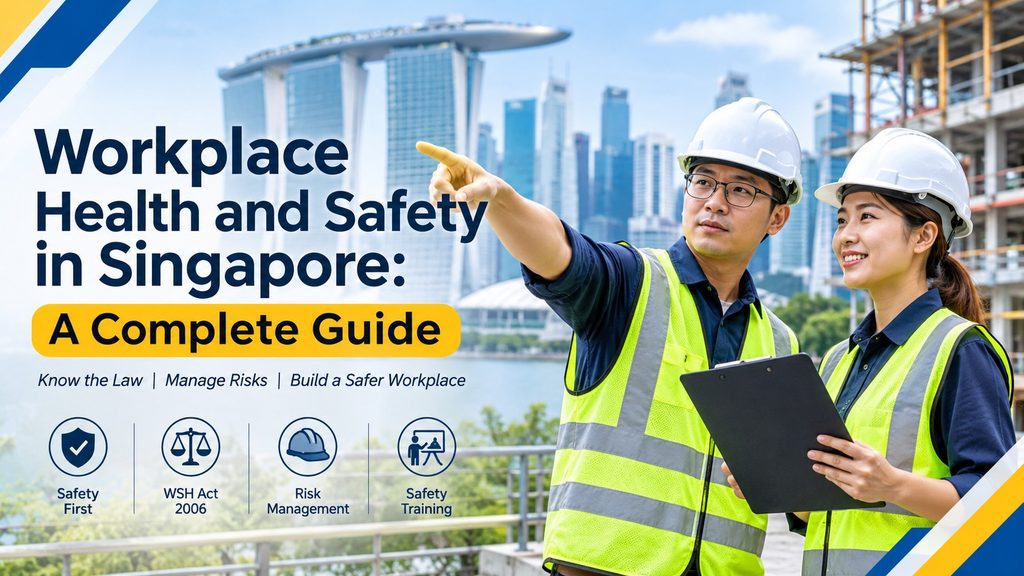
Workplace health and safety is an essential responsibility for every organisation operating in Singapore. From offices and commercial buildings to industrial facilities and construction sites, businesses must identify workplace hazards, manage operational risks, and protect employees, contractors, and others affected by their activities.
Singapore has established a comprehensive legal framework through the Workplace Safety and Health Act 2006 (WSH Act), supported by specific regulations and official workplace safety guidelines. Understanding these requirements helps organisations prevent accidents, improve working conditions and maintain a safer workplace.
What is workplace health and safety in Singapore?
Workplace health and safety refers to the policies, procedures and practical measures used to protect people from work-related injuries, illnesses and hazards. In Singapore, the Workplace Safety and Health Act 2006 establishes the legal framework for managing workplace risks and defining the responsibilities of employers, occupiers, principals and other duty holders.
What Is Workplace Health and Safety?
Workplace health and safety (WHS or WSH) involves identifying, assessing and controlling hazards that may affect people during work activities. It covers both physical safety and occupational health, ensuring that employees and other affected individuals can work in an environment where risks are properly managed.
Common workplace health and safety concerns include:
- Slips, trips and falls.
- Electrical hazards and faulty equipment.
- Fire and emergency risks.
- Exposure to hazardous substances.
- Unsafe machinery and maintenance activities.
- Working at heights.
- Poor workplace ergonomics.
- Occupational noise and health exposure.
- Inadequate ventilation and housekeeping.
- Contractor and visitor safety.
For example, a commercial building may have several maintenance activities taking place simultaneously. Cleaning teams, electrical technicians and air-conditioning contractors may work in different areas of the same facility. Without proper coordination, hazard identification and safety controls, these activities can create unnecessary risks.
An effective workplace safety programme helps organisations manage these risks before they lead to incidents.
What Is the Workplace Safety and Health Act in Singapore?
The Workplace Safety and Health Act 2006 is Singapore’s primary legislation for protecting the safety and health of people at work. It establishes general duties for employers, occupiers, principals, employees and other relevant parties to manage workplace risks, maintain safe working conditions and prevent work-related injuries and illnesses.
The Act was introduced in 2006 to strengthen Singapore’s approach to workplace safety by placing greater responsibility on those who create or manage workplace risks.
Rather than relying entirely on prescriptive safety rules, the WSH framework emphasises risk management and the responsibility of relevant stakeholders to take reasonably practicable measures to prevent harm.
The Act generally applies to workplaces in Singapore, subject to its provisions and applicable exemptions. Specific duties depend on the person’s role and the nature of the workplace or work activity.
Businesses should consult the latest version of the Workplace Safety and Health Act 2006 on Singapore Statutes Online when determining their legal obligations.
Why Is Workplace Safety Important for Singapore Businesses?
Workplace safety is not simply a regulatory requirement. It is an important part of responsible business operations, employee protection and long-term organisational performance.
1. Protecting Employees and Other People
A safe working environment reduces exposure to hazards that may cause injuries, occupational illnesses or serious accidents. Businesses must consider not only their employees but also contractors, visitors and other individuals who may be affected by their operations.
2. Supporting Legal Compliance
Singapore businesses must understand and comply with the Workplace Safety and Health Act and the regulations applicable to their activities.
Proper risk assessments, safety procedures, training and workplace inspections help organisations fulfil their responsibilities.
3. Reducing Operational Disruptions
Workplace accidents can interrupt daily operations, damage equipment and create unexpected costs. Effective safety management helps reduce preventable incidents and supports operational continuity.
4. Improving Employee Confidence
Employees are more likely to feel confident when their organisation takes workplace hazards seriously and provides appropriate training, equipment and supervision.
5. Strengthening Business Reputation
Clients, suppliers and business partners increasingly consider safety management when selecting service providers and contractors. Demonstrating a responsible approach to workplace safety can strengthen business relationships.
Who Is Responsible for Workplace Health and Safety Under the WSH Act?
The Workplace Safety and Health Act assigns responsibilities to different stakeholders according to their roles and involvement in workplace activities.
Employers
Under Section 12 of the WSH Act, employers must take reasonably practicable measures to ensure the safety and health of their employees and other persons who may be affected by their work activities.
Responsibilities include:
- Providing a safe working environment.
- Identifying hazards and conducting risk assessments.
- Implementing appropriate risk control measures.
- Providing suitable instruction, training and supervision.
- Maintaining safe machinery and equipment.
- Establishing emergency response arrangements.
Workplace Occupiers
Under Section 11, occupiers have duties relating to the safety and health of people within their workplaces.
These responsibilities include taking reasonably practicable measures to ensure that the workplace, access routes, machinery, equipment and substances under their control are safe.
This is particularly important for commercial buildings, industrial premises and facilities where multiple organisations operate.
Principals and Contractors
Principals and contractors must fulfil the duties applicable to their roles under the WSH Act.
Depending on the work arrangement, responsibilities may include:
- Ensuring contractors understand relevant workplace hazards.
- Coordinating safety measures between different work teams.
- Conducting appropriate risk assessments.
- Providing suitable information and supervision.
- Implementing controls for maintenance and construction activities.
Employees
Employees also have responsibilities under the Act.
They should:
- Follow workplace safety instructions.
- Use safety equipment correctly.
- Cooperate with workplace safety measures.
- Avoid unsafe behaviour.
- Report hazards and unsafe conditions.
- Take reasonable care of their own safety and that of others.
Workplace safety is most effective when management, employees and contractors work together.
Key Workplace Safety and Health Regulations in Singapore
In addition to the main WSH Act, Singapore has specific regulations covering different workplace hazards and operational activities.
The following regulations may be relevant depending on the type of workplace and work being performed.
| Regulation | Main Area of Focus |
| WSH (Risk Management) Regulations | Workplace hazard identification, risk assessment and control |
| WSH (Incident Reporting) Regulations | Reporting specified workplace accidents and dangerous occurrences |
| WSH (General Provisions) Regulations | General workplace safety requirements |
| WSH (First Aid) Regulations | Workplace first-aid arrangements |
| WSH (Work at Heights) Regulations | Managing risks associated with working at heights |
| WSH (Confined Spaces) Regulations | Safety requirements for confined-space work |
| WSH (Construction) Regulations | Safety requirements for construction activities |
Not every regulation applies to every organisation. Businesses should identify the legislation relevant to their workplace, equipment and activities.
For the latest requirements, refer to the MOM Workplace Safety and Health resources.
What Is Risk Assessment in Workplace Health and Safety?
Risk assessment is a systematic process used to identify workplace hazards, evaluate their potential risks and implement suitable control measures.
Under Singapore’s WSH (Risk Management) Regulations, employers, self-employed persons and principals have responsibilities for managing workplace risks.
The process generally involves three main steps.
1. Hazard Identification
Identify anything that could cause injury or illness.
Examples include:
- Wet floors in common areas.
- Exposed electrical wiring.
- Defective maintenance equipment.
- Falling objects.
- Unprotected work at height.
- Chemical exposure during cleaning.
2. Risk Evaluation
Evaluate the likelihood of an incident occurring and the potential severity of its consequences.
This helps organisations determine which hazards require immediate attention.
3. Risk Control
Implement appropriate measures to eliminate or reduce identified risks.
The hierarchy of control provides a structured approach:
- Elimination – Remove the hazard completely.
- Substitution – Replace the hazardous material or process with a safer alternative.
- Engineering controls – Isolate people from the hazard.
- Administrative controls – Introduce safe work procedures, training and supervision.
- Personal protective equipment (PPE) – Provide appropriate protective equipment.
PPE should not be treated as a substitute for higher-level controls where those controls are reasonably practicable.
Practical Example: Building Maintenance
Consider an air-conditioning maintenance team working at height in a commercial building.
Potential hazards may include falling, electrical exposure and dropped tools.
A suitable risk assessment would identify these hazards, evaluate their risks and determine appropriate controls, such as safe access equipment, isolation procedures, exclusion zones, trained personnel and suitable protective equipment.
Risk assessments should be reviewed when required, including following significant changes in work activities or after relevant incidents.
For official guidance, see MOM’s Risk Management Requirements.
Workplace Safety Training and Competency Requirements
Training helps employees and contractors understand workplace hazards and perform their duties safely.
The appropriate training depends on the nature of the work, the applicable regulations and the responsibilities of the individuals involved.
Common training areas include:
- Workplace safety orientation.
- Risk assessment training.
- Working at heights.
- Confined-space safety.
- Electrical safety awareness.
- Fire and emergency response.
- Safe machinery operation.
- Manual handling.
- Personal protective equipment.
Certain workplaces and job roles may have specific statutory training, registration or competency requirements.
For example, applicable requirements may cover Workplace Safety and Health Officers, coordinators and workers performing specialised activities.
Employers should verify course requirements and approved training arrangements through MOM and relevant official training information. Completing a general workplace safety course does not automatically satisfy every regulatory requirement.
What Happens If a Business Does Not Comply With the WSH Act?
Failure to comply with the Workplace Safety and Health Act may result in enforcement action and legal consequences.
Depending on the offence and circumstances, consequences may include:
- Regulatory investigations.
- Remedial orders.
- Stop-work orders.
- Financial penalties.
- Prosecution.
- Reputational damage.
- Operational disruption.
Under the WSH Act, the Commissioner for Workplace Safety and Health has powers to issue remedial orders and stop-work orders in appropriate circumstances.
Penalties differ according to the offence, the applicable statutory provision and whether the offender is an individual or corporate body.
Businesses should not rely on general penalty summaries to determine their potential legal exposure. Always check the relevant provision in the latest legislation.
For current information, refer to MOM’s WSH Act liabilities and penalties guidance.
How Can Businesses Improve Workplace Health and Safety?
Businesses can strengthen their workplace safety practices through consistent management, proper planning and regular monitoring.
The following steps provide a practical starting point.
1. Review Applicable Legal Requirements
Identify the WSH legislation and regulations relevant to the organisation’s operations.
2. Conduct Regular Risk Assessments
Assess routine and non-routine activities, including maintenance, cleaning, repairs and contractor work.
3. Implement Safe Work Procedures
Develop clear procedures for potentially hazardous activities and communicate them to the relevant personnel.
4. Provide Appropriate Training
Ensure employees and contractors receive the instruction, training and supervision required for their work.
5. Inspect Equipment and Facilities
Conduct suitable inspections and maintenance to identify unsafe conditions before they cause incidents.
6. Manage Contractors Properly
Communicate workplace hazards, coordinate activities and establish appropriate safety expectations before work begins.
7. Maintain Safety Records
Keep relevant risk assessment documents, inspection records, training information and incident reports.
8. Prepare for Emergencies
Establish appropriate emergency procedures and ensure that relevant personnel understand their responsibilities.
9. Review Workplace Incidents
Investigate incidents and near misses to identify underlying causes and prevent recurrence.
10. Monitor and Improve Safety Performance
Review safety procedures regularly and update them when workplace conditions or activities change.
How Facility Management Supports Workplace Health and Safety
Facility management plays an important role in maintaining safe, functional and well-managed buildings.
Commercial properties, industrial facilities and office environments require ongoing maintenance, inspections and operational coordination to minimise workplace risks.
Professional facility management can support workplace safety through several activities.
Building Maintenance and Equipment Safety
Regular maintenance helps identify defective equipment, damaged infrastructure and unsafe building conditions.
Workplace Inspections
Routine inspections can help identify hazards such as blocked access routes, damaged flooring, faulty lighting and unsafe common areas.
Fire Safety Coordination
Appropriate fire safety arrangements, equipment maintenance and emergency preparedness contribute to a safer building environment. These activities should be coordinated with the relevant fire safety professionals and applicable regulatory requirements.
Contractor Management
Facility managers often coordinate multiple contractors working within the same premises. Effective communication, work planning and safety coordination help reduce risks arising from simultaneous activities.
Emergency Preparedness
Emergency procedures, communication arrangements and coordination with relevant stakeholders help organisations respond more effectively to unexpected incidents.
Safety Documentation and Compliance Support
Maintaining relevant inspection records, maintenance documentation and safety procedures supports effective operational management.
For organisations seeking professional support, Vanguard Facility Management’s workplace safety, health and fire safety consultancy services provide a relevant starting point for exploring workplace safety and facility-related consultancy requirements.
Frequently Asked Questions About Workplace Health and Safety
1. What is workplace health and safety?
Workplace health and safety refers to the policies, procedures and control measures used to protect employees, contractors and other affected persons from work-related hazards, injuries and illnesses. It includes risk assessment, safety training, equipment maintenance, workplace inspections and emergency preparedness.
2. What is the Workplace Safety and Health Act in Singapore?
The Workplace Safety and Health Act 2006 is Singapore’s main workplace safety legislation. It establishes legal duties for employers, occupiers, principals and other relevant stakeholders to take reasonably practicable measures to protect people from workplace risks.
3. Who must comply with the WSH Act?
The WSH Act generally applies to workplaces in Singapore, subject to statutory provisions and exemptions. Employers, occupiers, principals, self-employed persons, employees and other specified stakeholders have duties according to their respective roles.
4. Is risk assessment mandatory in Singapore?
Yes. Under the WSH (Risk Management) Regulations, employers, self-employed persons and principals must conduct risk assessments for workplace activities and implement appropriate risk control measures. Assessments should be reviewed when required by the regulations and relevant changes in workplace conditions.
5. What are the main responsibilities of employers under the WSH Act?
Employers must take reasonably practicable measures to protect employees and other people affected by their work activities. These measures include providing safe working conditions, managing workplace risks, maintaining equipment and ensuring suitable instruction, training and supervision.
6. What are common workplace safety hazards?
Common hazards include slips and falls, electrical risks, faulty machinery, working at heights, hazardous substances, poor housekeeping, fire hazards and unsafe maintenance activities. The risks vary depending on the workplace and the nature of the work.
7. What happens if a company violates workplace safety regulations?
A company may face regulatory investigations, remedial or stop-work orders, financial penalties and prosecution, depending on the nature and seriousness of the offence. The specific consequences depend on the applicable statutory provision and circumstances.
8. Why is workplace safety important in facility management?
Facility management involves maintaining buildings, equipment, common areas and operational systems. Effective safety practices help identify maintenance hazards, coordinate contractors, maintain safe access routes and support emergency preparedness.
9. What is the difference between the WSH Act and workplace safety regulations?
The WSH Act establishes the main legal framework and general duties of relevant stakeholders. Subsidiary regulations provide more specific requirements for areas such as risk management, incident reporting, work at heights and confined-space activities.
10. How can a company improve workplace safety compliance in Singapore?
A company can improve compliance by reviewing applicable legislation, conducting risk assessments, implementing safe work procedures, providing suitable training, inspecting equipment, managing contractors and reviewing workplace incidents. Professional consultancy may also help organisations assess their safety management arrangements.
Conclusion: Building a Safer Workplace in Singapore
Workplace health and safety is a fundamental part of responsible business management in Singapore. Understanding the Workplace Safety and Health Act 2006, identifying workplace hazards and implementing appropriate risk control measures help organisations protect people and maintain safer operations.
However, effective workplace safety requires more than written policies. Businesses must regularly review their working conditions, maintain equipment, coordinate contractors and ensure that employees understand their safety responsibilities.
For organisations looking to strengthen their workplace safety arrangements, professional guidance can help identify opportunities for improvement and support more effective facility operations.
Explore Vanguard Facility Management’s workplace safety and health consultancy services to learn more about relevant workplace safety, health and fire safety support in Singapore.